

Access to Work
Employment that works
We publish new research today, funded by Trust for London, that Access to Work is one of the lowest cost, highest certainty, employment interventions in the DWP system.
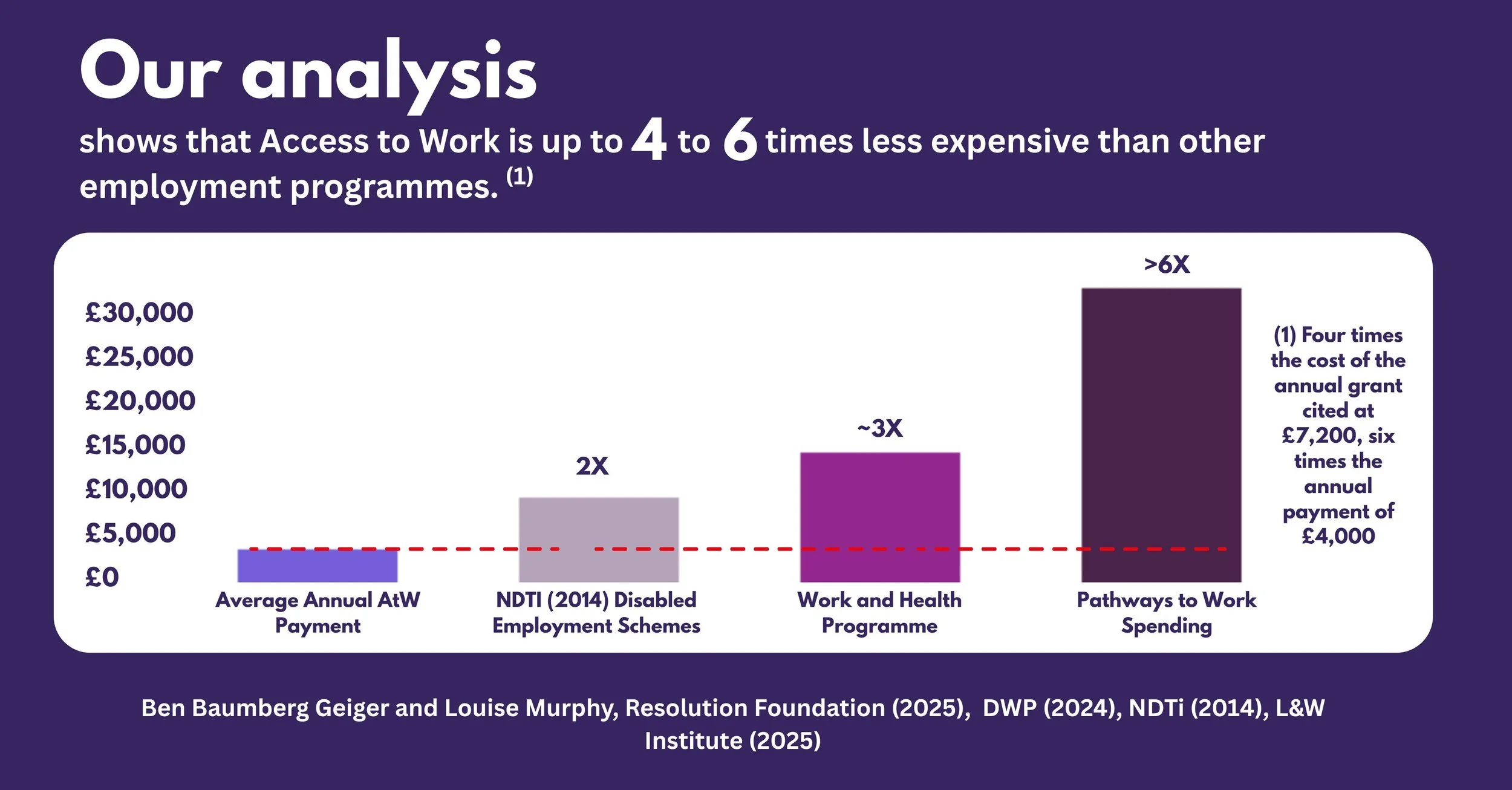
As this paper highlights, scaling it up could deliver stronger employment outcomes than expanding other job entry programmes, which can cost the government four to six times more per job outcome.
Our research estimates the average annual Access to Work payment to be £4,000 and cites the average grant per customer to be £7,200 to help keep a disabled person in a job. This compares very favourably to alternatives, when, the research shows, the government is spending over £25,000 per job outcome on new employment initiatives for disabled people.
Access to Work is a publicly funded employment scheme that helps disabled people start or stay in work by offering workplace equipment, money towards travel if public transport is inaccessible or an interpreter or support worker.
Reports over the past year have mounted over more “scrupulous” application of guidance in the Department for Work and Pensions, leading to a sharp increase in cuts to people’s support.
The National Audit Office say there are over 62,000 Access to Work applications that remain unprocessed and more than 32,000 outstanding payments, placing customers into debt and employers under financial distress.
At a time when closing the disability employment gap is high up on the political agenda, we urge the government to not waste time rewriting the wheel, but instead fund the scheme that has been proven to get results.
Our work highlights that failing to recognise how Access to Work supports employers in retaining disabled talent or preventing workplace exits, could be short-sighted. If the Access to Work scheme is cut, in its absence, we identify that additional healthcare and welfare costs could be £6m more than the current cost of the scheme. In the worst-case scenario, this figure could rise to £67m.
We therefore encourage the government to reallocate and reprioritise investment towards Access to Work, if it wants to truly play its part to close the disability employment gap. In this paper, we set out our case, alongside 12 policy proposals to deliver valuable reform to the system.